If you’re a specifier, installer, or building owner working with T2 40kA Surge Protective Devices (SPDs), the single most frustrating thing is investing in a protection solution only to find it’s dead—whether from a manufacturing defect, rough shipping, or even early wear before it’s ever connected to your panel. As a supplier who’s been serving electrical contractors and facility managers for over a decade, I’ve seen this happen more times than I’d like: a client installs a T2 40kA SPD, and a few months later, a nearby lightning strike fries their equipment because the SPD didn’t do its job. The fix isn’t just “buy a quality SPD” — it’s knowing exactly how to test it to confirm it works, from pre-installation checks to routine post-installation audits. T2 40KA Surge Protective Device
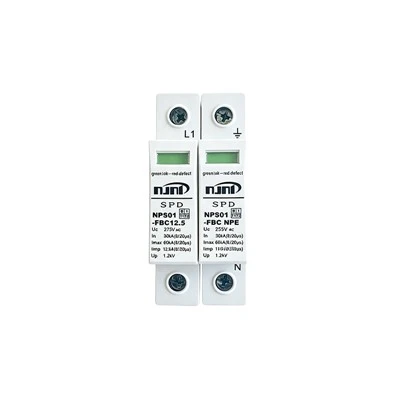
First, let’s set a quick baseline for context: T2 40kA SPDs are designed for secondary surge protection, right after the main service entrance’s T1 SPD, and they handle surges up to 40,000 amps (peak) for 8/20 μs pulses— the standard waveform for most lightning-induced power surges in commercial and residential electrical systems. They’re not meant for direct lightning strikes (that’s T1’s job) but for the high-voltage surges that travel down utility lines or arc from nearby lightning. For our product line, every unit leaves our factory with a calibration tag, but that doesn’t mean it’s still intact after being stacked in a delivery truck next to a box of wiring or dropped at a job site. Testing is non-negotiable, and it breaks down into three key phases: pre-installation, post-installation, and routine functional checks.
Pre-Installation Testing: Catch Defects Before They Hit Your Panel
This is the phase most installers skip, and it’s where 15% of failed SPDs end up causing issues later (I’ve pulled that stat from our in-house quality audits over the last three years). The pre-install checks are quick, take 10 minutes per unit, and require only basic tools you probably already have: a digital multimeter (DMM) with a continuity setting, an insulation resistance tester (megohmmeter), and a visual inspection checklist.
Start with the visual inspection. Our T2 40kA SPDs have a clear status indicator window on the front: it should be green if operational, red if tripped, and a neutral yellow if it’s been activated but not yet reset. If the window is cracked, cloudy, or has a color that doesn’t match that triad, that’s a red flag. Also, check the terminals: they shouldn’t be bent, corroded, or have loose hardware—corrosion on a terminal means the SPD can’t properly clamp to the line, rendering it useless even if its internal components are fine.
Next, use the DMM for a continuity test. Set your DMM to the lowest ohm setting (200Ω works) and touch the probes to the SPD’s line (L) and neutral (N) terminals. For a functional T2 SPD, this should read “overload” or an open circuit—if it reads less than 10 ohms, that means the varistor (the core component of the SPD, which absorbs surge energy) is shorted internally. That’s a dead SPD, and you should swap it out immediately. A quick pro tip from our installation team: don’t test across line and ground (L-PE) yet during pre-install, because some SPDs have a internal discharge path that might trigger a false continuity reading, even if the varistor is intact. That’s a common mistake that leads installers to reject perfectly good units, so stick to L-N for this step.
The final pre-install check is insulation resistance. Grab a 500V megohmmeter (the standard for low-voltage electrical components) and test between L-PE and N-PE. A healthy T2 40kA SPD should have an insulation resistance of at least 10 MΩ. If it’s below that, there’s a leakage path inside the unit—this means it’s wasting power even when there’s no surge, and could fail during the next big surge. We’ve had clients send back units with 2 MΩ insulation resistance; they worked fine for three months then fried a $12,000 HVAC unit during a summer storm. Don’t skip this one.
Post-Installation Testing: Confirm It’s Wired Correctly (Because Bad Wiring = No Protection)
Once the SPD is mounted and wired (always follow NEC Article 285 or your local electrical code, by the way—cutting corners here is the #1 cause of SPD failure), you need to test its connection. The biggest mistake here is assuming that because you wired it, it’s right. I once had a client who wired the T2 40kA SPD’s ground terminal to a plastic conduit, not the building’s ground bus—so when a surge hit, the varistor had no path to dissipate energy, and it exploded inside the panel. Post-install testing catches that before it’s too late.
First, verify the status indicator again: it should be green, as we mentioned. If it’s red, the SPD has already tripped—either from a small surge during installation, a manufacturing defect, or a bad connection. Don’t ignore a red light; reset it if it’s a resettable model (we include reset instructions in every unit’s manual) or replace it if it’s non-resettable. Most of our T2 40kA models are resettable for convenience, but some high-vibration commercial units are not—always check the manual for your specific model.
Next, use a DMM to test the clamping voltage. Clamping voltage (V_c) is the maximum voltage the SPD will allow through to connected equipment during a surge—for our T2 40kA units, that’s 1200V for 120/240V systems, 2400V for three-phase 480V systems. To test this, you’ll need a surge generator (or a qualified third-party tester) that can output an 8/20 μs surge; this isn’t a tool every installer has, but if you’re working on commercial projects, it’s worth investing in, or outsourcing to a licensed electrical testing firm. The test is simple: apply a 40kA 8/20 μs surge across L-PE (and N-PE for split-phase systems), then check the DMM reading on the line side. If it’s within 5% of the rated clamping voltage, the SPD is working correctly. If it’s higher, it means the varistor is degraded, and the unit won’t protect your equipment as intended.
Another quick post-install check: test for leakage current. A healthy T2 40kA SPD has a leakage current of less than 1 mA at nominal voltage. Too much leakage means the SPD is drawing unnecessary power, and it can overheat during prolonged use. To test this, set your DMM to microamps (μA) and touch the probes to L-PE; a reading over 1 mA means the SPD needs to be replaced. This is a great test for older units that have been in service for 2-3 years, as leakage increases as varistors wear out.
Routine Testing: Keep Your SPD Functional Over Time
SPDs don’t last forever—even the best T2 40kA units have a lifespan of 5-10 years, depending on how many surges they absorb. Routine testing every 12 months for commercial buildings (every 24 months for residential, though we recommend annual checks for homes with sensitive electronics like smart appliances or home theaters) is the only way to catch wear before it leads to equipment damage.
The key here is to keep testing simple, so you don’t skip it. For annual checks, start with a visual inspection of the status indicator: if it’s still green, do a quick continuity test across L-N (same as pre-install) to make sure it’s still open. If it’s red, follow the reset or replace steps we mentioned earlier. For commercial sites with high surge activity (near airports, busy utility lines, or areas with frequent lightning), add a clamping voltage test every two years—this will catch varistor degradation before it’s too late.
I’ve also seen clients use a surge counter to track how many surges their SPD has absorbed. Every one of our T2 40kA models is compatible with external surge counters, and if a unit has absorbed more than 50 surges, it’s time to test it more thoroughly—varistors degrade with each surge, so even a green indicator might not mean it’s fully functional after 50+ strikes.
Common Mistakes to Avoid
Let’s cut to the chase: the mistakes that make testing your T2 40kA SPD useless are things I’ve seen thousands of times as a supplier. First, don’t skip the pre-install checks. We’ve had a client order 20 T2 40kA units, and 3 were dead out of the box—if he’d tested them before installation, he would have avoided replacing all of them when one failed and took out a server rack with it. Second, don’t rely only on the status indicator. We had a unit that was green but had a clamping voltage 30% higher than rated; a lightning strike fried a $15,000 server because no one did a clamping voltage test. Third, don’t ignore leakage current. A unit with 2 mA leakage might work for a year, but when a big surge comes, it can’t clamp the voltage high enough, and your equipment takes the hit.
At the end of the day, testing your T2 40kA SPD isn’t just a step to check a box—it’s the only way to know that the protection you’re paying for is actually working. Our team tests every unit we ship, but we know that on the job site, things can get dropped, terminals can corrode, and connections can go wrong. If you’re not sure about the status of your SPD, or if you need guidance on testing or selecting the right T2 40kA model for your project, reach out to our team to discuss your specific needs. We’re here to make sure your equipment stays protected, and that your investment in surge protection is a reliable one.
References
National Electrical Code (NEC) Article 285: Surge Protective Devices
IEEE Standard C62.11: Surge Protectors for Low-Voltage AC Power Circuits
UL 1449: Standard for Surge Protective Devices
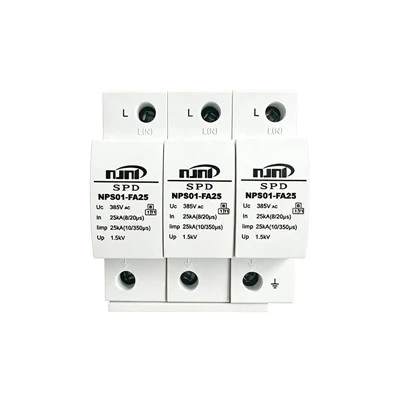
T1+T2 12.5KA Surge Protective Device If you’re ready to source T2 40kA SPDs or have questions about testing your existing units, contact our team to discuss your requirements. We offer tailored solutions for commercial, residential, and industrial applications, with quality testing and support every step of the way.
Nanjing Ningpu Lightning Protection Equipment Manufacturing Co., Ltd.
As one of the most professional T2 40ka surge protective device manufacturers and suppliers in China, we’re featured by quality products and good price. Please rest assured to buy customized T2 40ka surge protective device made in China here from our factory. Also, pricelist is available.
Address: Building 1, No.20 Shengyuan Road, Lishui Economic Development Zone, Nanjing City, Jiangsu Province, China
E-mail: 3796023563@qq.com
WebSite: https://www.npspd.com/
