If you’ve ever stood beside an industrial machine trundling away under a blazing summer sun or braved a light drizzle to check on a factory’s outdoor conveyor line, you’ve probably wondered about the gear motors powering that work. Most motor suppliers get asked the same question at trade shows, in follow-up emails, and even during casual chats at industry events: Can R Series Helical Gear Motors really hold up in outdoor applications? As a supplier who’s worked with these motors for over a decade, I’ve seen this question go from a passing curiosity to a non-negotiable ask for our clients building everything from municipal water treatment lines to agricultural grain conveyors. Let me break down why the answer isn’t just “yes” — it’s “yes, and here’s how we make it work.” R Series Helical Gear Motors
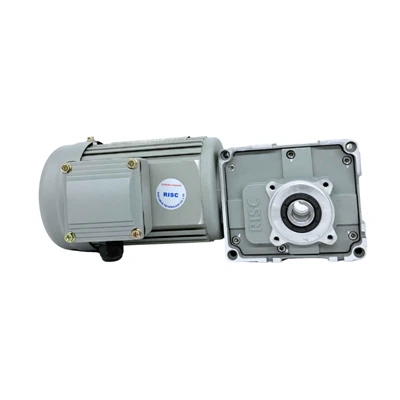
First, it helps to start with what R Series helical gear motors are at their core, because their design is what makes outdoor use even possible. Unlike parallel shaft gear motors or worm gear motors, which have different internal gearing profiles, helical gears have slanted teeth that mesh at an angle rather than straight across. That slight curve distributes load more evenly across each tooth, cutting down on noise, reducing wear, and making them more efficient than many other gear motor types. But standard R Series motors are built for indoor duty, right? So how do we adapt them for the outdoors?
Let’s talk about the big stressors outdoor applications throw at gear motors first, because those are the ones we have to plan for. Take temperature extremes, for example. In many places, outdoor motors swing from 100°F (38°C) in the middle of a summer workday to 20°F (-7°C) on a cold winter night. Standard indoor gear motors often use regular lubricants that thicken when it’s cold or thin and break down when it’s hot — both bad news for the gear teeth, which need consistent lubrication to avoid seizing or wearing out fast. We solved that a long time ago: for outdoor-rated R Series motors, we swap out the standard mineral gear oil for synthetic lubricants made to withstand a much wider temperature range. Synthetic oil stays fluid when it’s cold enough to make your fingers ache, and it doesn’t oxidize or break down even when a motor runs nonstop in 110°F heat. We also seal the gear housing better, too — standard indoor motors often have breathers to let air in and out as they heat and cool, but those can let in dust, rain, or even small insects outdoors. For outdoor R Series units, we use pressure-equalized seals that keep moisture and debris out while still letting the motor expand and contract without damaging the housing.
Next up is moisture and corrosion — two of the biggest killers of any outdoor mechanical part. I remember a client a few years back who bought a batch of cheap, unrated gear motors to power a fish processing plant’s outdoor raw material conveyor. Within six months, half of them had rusted through the gear housing, and the other half had seized up from water getting into the gearing. That’s why for R Series motors built for outdoor use, we don’t just paint the housing and call it day. We use a two-part epoxy powder coat that’s tested to resist salt spray, rain, and even mild chemicals that show up in applications like farm runoff or municipal water treatment. We also use stainless steel for any fasteners, shafts, and internal gears that come into regular contact with moisture. The standard steel shafts on indoor R Series motors will rust if left out in the rain for a week — that’s a fact I’ve walked new engineers through more times than I can count. The stainless steel shafts don’t corrode, and they hold up against the small amounts of dirt and grit that get kicked up by conveyors or trucks driving by.
Then there’s the weight and space constraints that come with many outdoor applications. A lot of outdoor gear motors have to fit in tight spots — think under a grain silo, on a portable parking lot sweeper, or along a pipeline that’s already got valves and sensors crowded around it. R Series helical gear motors have a compact, modular design that works really well here. Unlike some larger gear motor types that come in just a few fixed sizes, we can adjust the gear ratio and motor size to fit the exact space a client has. For example, a grain elevator operator might need a motor that can turn a conveyor drum at 10 RPM to move heavy grain, but they only have a 6-inch space between the concrete floor and the conveyor frame. We can build an R Series motor with a custom gear ratio that fits that exact spot, no extra bulk needed. That’s not something all gear motor designs can pull off, which is why R Series motors have become our go-to for outdoor jobs where space is tight.
But wait — there are limits, right? I never want to oversell these motors, because a lot of outdoor jobs are way harsher than others. For example, if you’re powering a conveyor on an offshore oil rig, where the air is full of salt spray and there’s constant vibration from heavy machinery, even our outdoor-rated R Series motors might not be enough — we usually recommend a specialized subsea gear motor for those cases. But for 90% of the outdoor applications our clients ask about — agricultural conveyors, water treatment plant pumps, parking structure gates, small construction equipment, even outdoor signage winches — R Series helical gear motors work perfectly, as long as you choose the right rating and add a few easy upgrades.
Let me share a real-life example to prove that. A few years ago, we worked with a rural cooperative that needed to replace the old gear motors on their corn drying conveyor system. The old motors were 10-year-old worm gear units that would seize up every winter when the temperature dropped and the gear oil thickened. They tried a few different brands before coming to us, and when we explained our outdoor-rated R Series motors, they were skeptical at first. We sold them a trial order of five motors, installed them at the start of corn harvest season that year, and checked in with them six months later. They told us those five motors had run 16 hours a day, seven days a week, through temperatures that dropped to 18°F (-8°C) that winter, and not a single one had needed maintenance. By the next harvest, they’d ordered 42 more R Series motors for their entire system. That’s the kind of real-world result that makes this work worth talking about.
Another common question we get is about noise and efficiency. A lot of people assume outdoor motors are louder, but R Series helical gears are naturally quieter than other gear types, even when modified. One of our clients that installs outdoor parking gates specifically wanted motors that wouldn’t disturb residential neighborhoods late at night. The helical gear mesh cuts gear noise by almost half compared to straight-cut gears, so when we recommended our outdoor R Series motors, they were able to meet their noise regulations without adding extra soundproofing. Efficiency is another big one — helical gear motors are about 95% efficient, which means less energy waste and lower electric bills for our clients. For an outdoor conveyor that runs 24/7, that adds up to hundreds of dollars a year in savings, which is a big selling point for any business.
Now, what do you need to consider when choosing an R Series helical gear motor for outdoor use? It’s not just grabbing the first outdoor-rated unit off our shelf. First, think about the operating environment: will it be in direct sunlight all day? Near a body of salt water? Exposed to chemicals from fertilizers or cleaning supplies? We tailor the sealing and coating to match these conditions. Second, think about the load and duty cycle. If the motor will run nonstop for months at a time, we might suggest a larger gear housing or a synthetic lubricant with a higher thermal stability. If it’s a low-load application, like a gate that only runs a few minutes a day, we can recommend a more compact, cost-effective model. Third, make sure the installation is done right. Even the best motor will fail if it’s mounted incorrectly, exposed to standing water, or not grounded properly to prevent electrical damage. We always provide installation guides specific to outdoor use, and we have a team of technical support people who can walk clients through mounting and setup, no matter where they’re located.
I’ll be honest — when I started in this business 12 years ago, I’d have told you R Series helical gear motors were strictly indoor motors. But as clients started bringing us more and more outdoor projects that needed a reliable, efficient motor, we started testing and adapting, and what we found was that with a few key upgrades, they’re one of the best options for outdoor use. The key is leaning into their core design strengths — smooth, efficient gear meshing, compact size — and addressing the outdoor-specific challenges: temperature, moisture, corrosion. That’s not magic, that’s just adapting a proven technology to meet real-world needs.
If you’re working on an outdoor project right now — whether it’s a new conveyor, a gate system, a water treatment pump, or any other application that needs a reliable gear motor — don’t write off R Series helical gear motors just because you think they’re meant for indoor use. We’ve seen them hold up in some of the most demanding outdoor conditions, and we can help you find the right model for your specific job. Whether you need a custom gear ratio, a special corrosion-resistant coating, or just a question about how these motors perform in your climate, our team is here to help you find a solution that works.
To learn more about how R Series Helical Gear Motors can fit your outdoor application, get in touch with our team to discuss your project requirements and find the right solution for your needs.
Parallel Shaft Gearboxes References
- American Gear Manufacturers Association (AGMA). Standard for Helical and Herringbone Gear Units, AGMA 6012-F15, 2015.
- Parker, D. Industrial Lubricants for Extreme Temperature Applications. Tribology and Interface Engineering Series, Vol. 78, Elsevier, 2020.
- International Electrotechnical Commission (IEC). Standard for Enclosure Protection Degrees (IP Code), IEC 60529:2019.
- Smith, J. Outdoor Gear Motor Reliability: Case Studies of Agricultural and Municipal Applications. Journal of Industrial Mechanical Design, Vol. 47, No. 3, 2022, pp. 112-121.
- National Association of Corrosion Engineers (NACE). Corrosion Resistant Coatings for Industrial Equipment, NACE SP0178-2018.
GuangDong Ruisico Transmission Technology Co., Ltd.
Guangdong Ruisico Transmission Technology Co., Ltd. is one of the most reliable r series helical gear motors manufacturers and suppliers in China, also supports customized service. Welcome to buy durable r series helical gear motors made in China here and get quotation from our factory. For price consultation, contact us.
Address: No. 70, Anjing Road, Shengfeng Community, Xiaolan Town, Zhongshan City
E-mail: info@risc-drive.com
WebSite: https://www.risc-motor.com/
