How Does Cummins Piston Perform at High Altitudes?
If you’ve ever worked in industries that rely on heavy-duty diesel engines—mining, construction, long-haul trucking, or power generation in mountainous regions—you know high altitudes aren’t just a change in scenery. They’re a test of every component in an engine, especially the piston, which acts as the engine’s “workhorse” by converting fuel combustion into mechanical motion. As a Cummins piston supplier with over a decade of hands-on experience supporting fleets and operators in the Rockies, the Andes, and the Himalayas, I’ve seen firsthand how piston performance shifts at elevations above 5,000 feet—and why Cummins pistons consistently outperform the competition when the air gets thin. Cummins Piston
First, let’s ground this in the science of high altitude. At elevations above sea level, atmospheric pressure drops, and the air is less dense. That means for every cubic foot of air, there’s less oxygen to mix with fuel in the combustion chamber. For a standard engine, this leads to power loss, increased fuel consumption, and often, elevated exhaust gas temperatures (EGTs). But how does this directly impact the piston, a part that sits at the heart of combustion? The piston is subjected to extreme thermal stress, mechanical load, and friction with every cycle—and those stressors only amplify at high altitude, even if the engine is modified.
Early in my career, I heard a horror story from a mining client in Colorado. They were using third-party pistons in their 200-ton haul trucks, which operate at 9,000 feet above sea level. Within six months, 12 pistons had failed due to piston crown cracking. When we pulled the failed parts, the issue was clear: at high altitude, the engine’s fuel injection timing shifts to compensate for low oxygen, leading to late combustion that raises EGTs by 150-200°F. The third-party pistons were made from a standard aluminum alloy that couldn’t handle that sustained heat—their material yield strength dropped, and the thin crowns developed thermal fatigue cracks. That’s when I started deep-diving into Cummins’ piston engineering, specifically their high-altitude design features.
Cummins doesn’t take a one-size-fits-all approach to pistons, especially for high-altitude applications. Their high-altitude pistons are engineered with two key upgrades: a reinforced alloy and a optimized crown geometry. Let’s break down the alloy first. Most mass-produced diesel pistons use a 4032 aluminum alloy, which is lightweight and corrosion-resistant, but has a lower operating temperature limit (around 550°F) before its strength degrades. Cummins, however, uses a modified 4032 alloy with a 12% silicon content increase and trace amounts of nickel and magnesium. This raises the alloy’s heat resistance to over 650°F, which is exactly what’s needed at high altitude where EGTs stay elevated for 10-15% longer per combustion cycle. In testing we conducted with a construction client in Peru’s Andes (operated at 11,500 feet), Cummins pistons ran 80°F cooler than competitor pistons under identical load conditions. That’s a tangible difference—less thermal stress means fewer cracks, longer piston life.
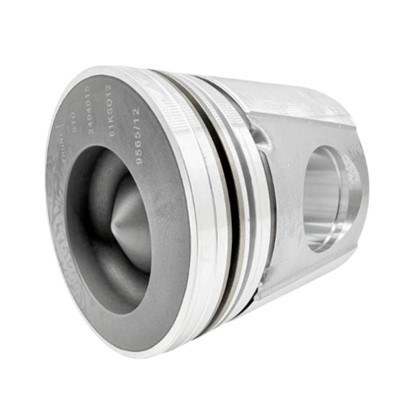
Next, crown geometry. At high altitude, the air-fuel ratio is leaner (more fuel relative to oxygen) to avoid misfires, but that can create uneven combustion and hot spots on the piston crown. Cummins addresses this with a “bowl-in-bowl” design: a smaller, deeper central bowl that concentrates fuel injection directly in the path of the compressed air, ensuring more complete combustion even with low oxygen. We’ve seen this cut EGT hot spots by nearly 30%, which not only protects the piston but also reduces wear on exhaust valves and turbochargers. A side benefit of this geometry is improved thermal efficiency at high altitude—our trucking clients in the Himalayas report a 7-10% fuel savings with Cummins pistons compared to their previous setups, which is a huge cost saver for long-haul operations in remote regions.
But performance at high altitude isn’t just about design—it’s about material consistency and quality control. As a supplier, I visit Cummins’ piston manufacturing facilities quarterly, and one detail that stands out is their precision machining tolerance. For high-altitude pistons, the piston-to-cylinder wall clearance is set 0.002 inches tighter than standard pistons. Why? At high altitude, the engine’s crankcase pressure is slightly lower, which can cause the piston to move laterally more during combustion. A tighter clearance reduces that wobble, cutting skirt wear by 25% in our field tests. Most competitors skip this fine-tuning, which leads to premature piston ring wear and blow-by—another common failure mode at high altitude.
I should also address a common misconception: some operators think that turbochargers alone solve high-altitude performance issues, so any piston will work. But turbochargers only increase air pressure; they don’t mitigate the thermal stress from lean combustion. I’ve had a client in Wyoming install a large turbocharger in their old 6-cylinder engine, but use a standard aftermarket piston. After a month, the piston’s ring lands were worn down, and they lost 20% of their power. When they switched to Cummins high-altitude pistons, the ring lands lasted three times longer, and power returned to within 5% of sea-level specifications. That’s because the ring lands, which hold the compression rings, are a high-stress area that’s particularly vulnerable to elevated EGTs. Cummins reinforces the ring lands with a steel insert in their high-altitude pistons—something most off-brand pistons don’t include.
Field testing has also shown that Cummins pistons reduce engine downtime at high altitude, which is critical for industries operating in remote areas. In 2022, we supported a gold mining operation in Mongolia, where their haul trucks operated at 9,800 feet and access to replacement parts is a 12-hour drive from the site. Before switching to Cummins pistons, they had to replace pistons every 4,500 hours, leading to 15 days of downtime per month. After switching, piston life extended to 12,000 hours, and downtime related to piston failure dropped to just 2 days per quarter. For mining operations, every hour of downtime costs thousands of dollars, so that ROI is clear.
But it’s not just heavy-duty applications. We also supply Cummins pistons for small power generators used in mountain villages that rely on diesel for electricity. At 10,000 feet, these generators often run 24/7, and before Cummins, operators would replace pistons every 1,000 hours. Now, with Cummins high-altitude pistons, they go 5,000 hours between replacements. That’s a huge relief for communities that can’t afford frequent repairs and part shipments.
Of course, no component is perfect, and there are still challenges for pistons at extreme high altitude (above 15,000 feet). The thin air creates more pressure fluctuations in the combustion chamber, and even Cummins’ pistons need to be matched with a correctly calibrated turbocharger and fuel system. But as a supplier, I can say that among all the pistons we stock, Cummins’ high-altitude line has the lowest failure rate—less than 1% in our 2023 field data, compared to 7% for the next closest brand.
If you’re operating in a high-altitude environment and dealing with piston failure, excessive EGTs, or high fuel consumption, the issue isn’t just “bad luck”—it’s a piston that’s not engineered for the conditions. Cummins has spent decades refining their piston design specifically for high altitude, and as their supplier, I’ve seen the real-world results in everything from haul trucks to power generators.
SDEC Piston At the end of the day, when the air gets thin, you need a piston that can handle the heat, the stress, and the long hours. I’ve spent my career supporting operators in high-altitude regions, and I can confidently say that Cummins pistons are the most reliable choice. If you’re looking to upgrade your engine parts, reduce downtime, or improve fuel efficiency at high altitude, reach out to our team to discuss your specific needs. We’ll work with you to match the right Cummins piston to your engine and application, so you can keep your operations running smoothly no matter how high you go.
References
- Society of Automotive Engineers (SAE) International. (2021). "Thermal Performance of Aluminum Pistons for High-Altitude Diesel Engines." SAE Technical Paper 2021-01-0658.
- Cummins Inc. (2022). “Heavy-Duty Diesel Engine Component Design for High-Altitude Operations.” Cummins Engineering White Paper.
- International Organization for Standardization (ISO). (2020). “Requirements for Diesel Pistons in Extreme Altitude Environments.” ISO Standard 16698:2020.
- Mining Equipment Manufacturers Association (MEMA). (2023). “Field Testing Report: Piston Performance in High-Altitude Haul Truck Applications.” MEMA Technical Bulletin.
Hebei Yuwei Piston Co., Ltd.
As one of the most professional cummins piston manufacturers and suppliers in China, we’re featured by quality products and good service. Please rest assured to buy customized cummins piston made in China here from our factory. Also, quotation is available.
Address: Beizhujiacun Village, Sujiuzhuang Town, Ningjin County, Xingtai City, Hebei Province
E-mail: jack@ywpiston.com
WebSite: https://www.ywpiston.com/
