What’s up turf fam? If you’ve ever stood in a stadium after a soccer game, you’ve probably thought, “That turf looks way more durable than the stuff a neighbor down the street has in their backyard.” As a commercial artificial turf supplier who’s been deep in this game for 8 years, I get it—most people don’t realize there’s a huge gap between commercial and residential turf when it comes to performance. I’ve fielded so many calls from property managers who tried to save a buck by going residential for their soccer fields or restaurants’ patio areas, and homeowners who accidentally bought the “cheapest turf online” only to have it flattened in 6 months. Today, let’s break down how these two stacks up, no fancy jargon, just real stuff I see every day. Commercial Artificial Turf

First, let’s talk about wear and tear—this is where the biggest difference lives. Commercial turf is built for non-stop, heavy use. I’ve supplied fields that see 20+ hours of play a week, plus football practices, birthday parties, and even occasional tailgates, and that turf still holds up. How? The infill and the backing are the workhorses here. Commercial turf uses a denser, thicker backing—usually 10 ounces or more per square yard—compared to residential, which is often 6-8 ounces. That backing is the foundation; if it’s thin, it’ll stretch, wrinkle, or even tear when you’re dragging coolers, setting up bleachers, or kids sliding into base after base. The infill too: commercial turf uses silica sand or rubber infill that’s compacted a lot more tightly, sometimes with a sand cap on top to keep blades upright. On residential turf, the infill is usually lighter, just enough to make the blades stand, so if you have a dog that runs laps every day or a big family hosting cookouts, that infill will shift, leaving bald spots. Last year, I had a local park come to me—they installed residential turf for their community play area 18 months prior, and it was so flattened that you could step on a spot and feel the ground underneath. That’s the kind of headache commercial turf avoids.
Next, drainage and weather performance. Nobody wants a puddle that sits for days after a rain, right? Commercial turf has a perforated backing—holes all over it so water can drain through quickly. It’s tested to handle up to 50 inches of rain an hour, which is way more than residential turf’s standard 20-30 inches. I had a client a few months back who has a restaurant patio; last summer we had 3 inches of rain in an hour, and their commercial turf had zero standing water. The old turf they had before was residential, and the patio was closed for 2 days because the water wouldn’t go anywhere. Also, commercial turf blades are usually made of polyethylene that’s UV-stabilized for 8-10 years. Residential? A lot of cheaper options use polypropylene, which fades fast—like, in a year it goes from bright green to a dull gray. I’ve had clients show me residential turf they bought from a big box store, and after one summer, the blades were so faded you could barely tell it was green. Commercial turf’s UV inhibitors are way stronger, so it stands up to intense sun, which is huge for fields in places like Texas or Florida that get 12 hours of sun a day.
Then there’s traction and safety, which is make-or-break for commercial use, especially for sports. Commercial turf blades are taller and have a more textured surface—they’re not just flat plastic. That texture gives traction, so players don’t slip when they’re making a quick cut or sliding. Residential turf blades are shorter and smoother, so if you have a basketball half-court in your backyard, you might slip if it’s wet. Also, infill in commercial turf is often rounded rubber, which is softer if someone falls. Residential infill is usually just sand, which is harder—so I’ve heard of homeowners cutting their feet on that sand-infused turf when they ran too fast. For commercial properties, safety is non-negotiable; we test all our turf for ASTM standards for fall height, so if a kid falls off a playground structure onto our turf, it’s way less likely to get hurt. Residential turf rarely goes through that kind of testing, so you’re taking a risk if you use it for active play areas.
Wait, let’s address the cost elephant in the room, because I know that’s a big reason people mix them up. Commercial turf is more expensive upfront—usually 20-30% more per square foot than residential. But here’s the thing: it’s an investment. Residential turf might look cheaper, but if it wears out in 3 years, you’re redoing it, which ends up costing more than installing commercial once. Last year, I had a school district that tried to save $5,000 by going residential for their practice field, and 2 years later they had to replace it, paying $12,000 total. That’s a huge waste. Commercial turf’s lifespan is 10-15 years, compared to residential’s 5-7 years, so over time it’s actually cheaper. Also, commercial turf doesn’t need as much maintenance? Wait, no—let’s be real, both need some upkeep. Commercial turf needs regular brushing to keep infill from shifting, but residential turf needs more—you have to rake the blades, replace infill that’s washed away, spot treat for pet stains a lot more because the infill is thinner.
I get why people might think “turf is turf,” but it’s not. A backyard with a small patio for family is totally different from a soccer field that’s used by 100 people a week, or a retail parking lot that needs to hold up to carts and heavy foot traffic. A lot of suppliers will sell you residential turf for commercial use to make a quick sale, but that’s not the right fit. I’ve seen too many properties end up with problems because they skipped the commercial grade.
If you’re a business owner, property manager, or someone looking for turf that can handle constant use, don’t settle for residential. Our commercial turf is built exactly for that—we source the thick backing, UV-stabilized blades, and compacted infill that can go through rain, sun, and heavy activity without breaking. We’ve installed fields, patios, and playgrounds all over, and we stand behind our product. If you’re tired of turf that gives out after a year, or you’re planning a project that needs something reliable, hit me up to chat through what you need. We can go over pricing, talk about maintenance, and make sure you get the right turf for your space.
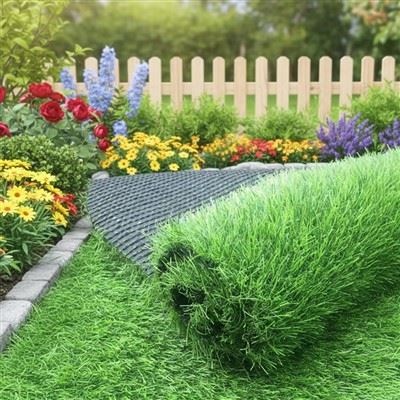
Don’t waste money on cheap, residential turf that won’t last. Let’s get you something that works for the long haul.
Garden Artificial Turf References:
- American Society for Testing and Materials (ASTM). (2022). Standard Specification for Artificial Turf for Use in Outdoor Sport and Recreational Surfaces. ASTM International.
- Turf Manufacturers Association. (2023). Performance Characteristics of Commercial vs. Residential Artificial Turf. TMA Technical Report.
- Outdoor Power Equipment Institute. (2021). Maintenance and Durability Guidelines for Synthetic Turf Installations. OPEI Publication.
- University of Georgia Extension. (2022). Synthetic Turf Selection for Commercial and Residential Applications. UGA Extension Bulletin 1457.
Yiwu Duofu Artificial Flower Co., Ltd.
As one of the most professional commercial artificial turf manufacturers and suppliers in China, our products have good reputation in the market. Please feel free to wholesale bulk custom made commercial artificial turf from our factory. Good service and quality products are available.
Address: Building B, No. 566 Chunhua Road
E-mail: 13373813738@aliyun.com
WebSite: https://www.chinaturffactory.com/
